

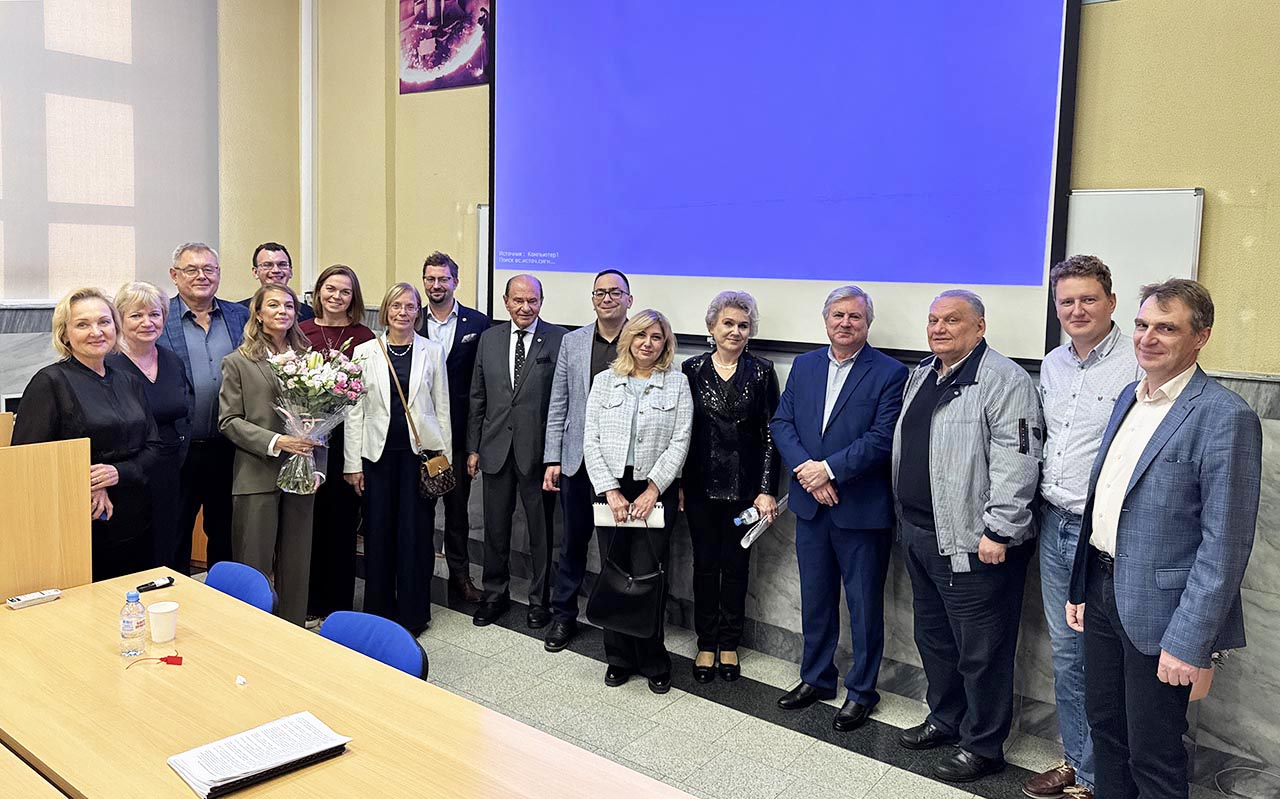
September 9, 2026. On September 9, 2026, a Scientific Seminar of the Geophysical Center RAS was held online.
Research Scientist at the Schmidt Institute of Physics of the Earth of the Russian Academy of Sciences, Natalya Valeryevna Savelyeva, presented a report titled "Interaction Between the Technosphere and the Ionosphere: Growth in the Intensity of Anthropogenic VLF Radiation in the Upper Ionosphere" (based on materials from her PhD thesis).
The report provided an overview of the possible effects of technological systems on the near-Earth environment. One manifestation of such impact is the penetration of electromagnetic radiation in the VLF range (tens to hundreds of Hz) into the upper ionosphere and magnetosphere. Signs of such influence were detected several decades ago, but real opportunities for studying this phenomenon emerged with the advent of low-orbit satellites equipped with highly sensitive instruments.
The sources of VLF radiation are large-scale systems, 100 km in length and more. This study investigated the parameters of the field created by the ZEVS VLF transmitter on the Kola Peninsula and by main power transmission lines with voltages above 300 kV in Russia, Canada, Japan, and South Korea. Studying the spatial, frequency, and energy characteristics of such a field makes it possible to assess the degree of influence of large industrial systems on the near-Earth environment.
The study used data from the Chinese satellite CSES-01 (orbit at an altitude of ~500 km). The satellite's scientific equipment includes an induction magnetometer and an electric field detector, which make it possible to study variations in the components of the magnetic and electric fields along the orbit. Data from the Russian satellites Ionosphere-M, deployed in 2024 in orbits at an altitude of 830 km, were also used. Their scientific equipment includes sensors for measuring variations in the magnetic and electric fields with high resolution.
Electricity production on Earth is constantly growing, and the length and coverage area of power transmission lines, as well as their voltage and capacity, are increasing. Studying various aspects of the influence of such systems on the ionosphere, magnetosphere, and the Earth's radiation belts is of both scientific and practical interest.



 Analytical Geomagnetic Data Center
 Space weather parameters
 Virtual Magnetograms