

September 29, 2026. An international scientific team has presented new data on the secondary alterations and composition of felsic tuffs from Upper Sarmatian and Maeotian-Pontian continental sedimentary rocks of the Udabno Upper Miocene section (Kakheti, Eastern Georgia, Eastern Paratethys). The lead author of the study was D.Sc. Yuliana Rostovtseva, Chief Researcher at the Geophysical Center RAS.
The study of volcanic tuffs allows us to determine the stages and characteristics of volcanic eruptions, facilitates regional correlations, enables radiometric dating of rocks, and helps to identify the features of secondary alterations in pyroclastics.
Numerous layers of volcanic tuffs are present in the Upper Miocene sediments of Eastern Georgia (Eastern Paratethys). Extensive volcanic activity occurred there from the Late Miocene to the Holocene. The eruption products are mainly represented by calc-alkalineandesites, dacites, rhyolitic dacites, and rhyolites.
The purpose of a new study was to examine the secondary alterations and chemicalcomposition of tuffs from an Upper Miocene sedimentary sequence in eastern Georgia (Udabno section, Kakheti). It was conducted by scientists of the Geophysical Center RAS, the A. Janelidze Institute of Geology, the Center for Energy Science and Technology at Skoltech, and the A. Nazarov Institute of Geophysics and Engineering Seismology of the National Academy of Sciences of the Republic of Armenia.
The study can be found in the Russian Journal of Earth Sciences.
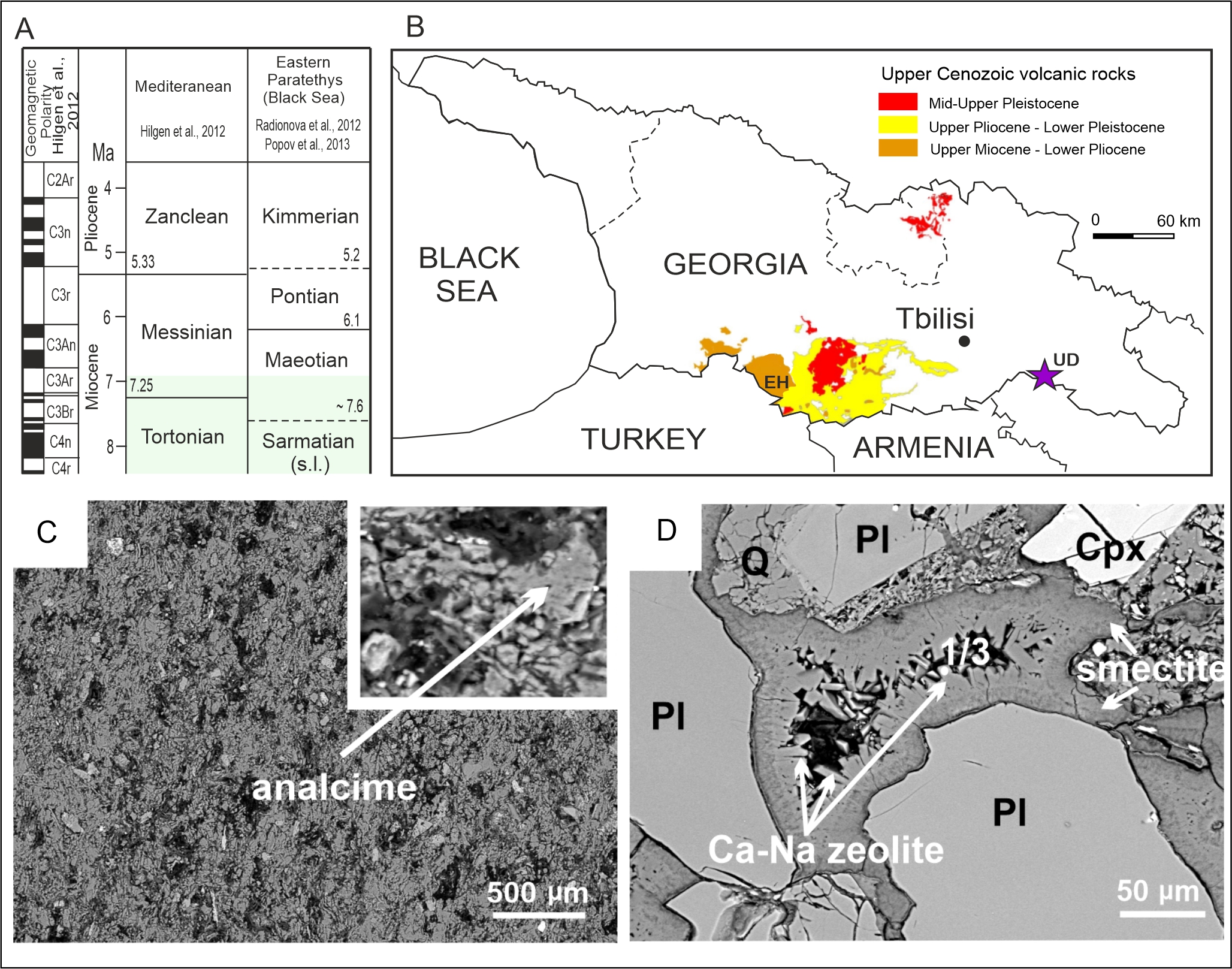 The studied stratigraphic interval (a); Late Cenozoic volcanic formations of Georgia (after Okrostsvaridze et al., 2017); location of the Udabno section in Eastern Georgia (b); zeolites from interlayers of volcanic ashes of the Sarmatian (c) and Maeotian-Pontian (d). RJES / Yu. V. Rostovtseva et al., 2026.

 Analytical Geomagnetic Data Center
 Space weather parameters
 Virtual Magnetograms